
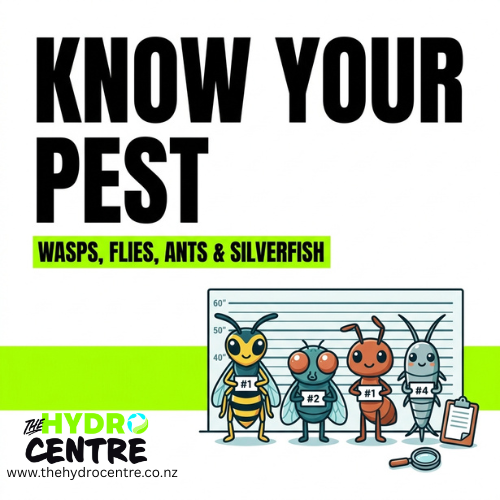
A trap only works if it suits the pest. Wasps, flies, ants and silverfish each have their own habits and weak spots, and the wrong bait or the wrong placement means a trap that catches nothing.
Spring is the best time to act, because most of these pests are only just getting started. Here’s what each one does, the damage it causes, and how to manage it. Where one of our reusable NZ-made traps fits, we’ve said so.
1. Wasps
What you’re dealing with
Three wasps cause most of the trouble in New Zealand. German and common wasps (the “yellow wasps”) are black and yellow, build enclosed paper nests in the ground, walls or trees, and swarm when disturbed. Paper wasps are longer and slimmer, with a narrow waist, and build small open combs under eaves and on fences. They’re less aggressive but will defend the comb. All three are introduced pests.
The season
A wasp colony lasts one year, and timing matters.
- Spring (Sept–Nov): Queens come out of hibernation and start a nest. The first workers hatch by November, and they forage for protein to feed the grubs.
- Summer (Dec–Feb): The colony grows into the thousands, and the workers switch to sugar, which is why they end up at your barbecue.
- Autumn (Mar–May): This is the peak, and a single German wasp nest can hold over 5,000 workers. It’s also when most stings happen.
- Winter: The colony dies off and only mated queens survive, hibernating in sheltered spots like wood piles and roof spaces.
The damage
- Fruit damage. They chew ripe and fallen fruit.
- Environmental harm. They compete with native birds and insects, especially in South Island beech forests.
Managing them
- Start early. Every worker caught in spring is one that won’t help feed the colony all summer.
- Match the bait to the season. Use a scrap of raw meat or fish in spring, then sugar water or a little beer in summer and autumn. Never use honey, because it attracts bees.
- Place traps away from where you sit. Hang them a few metres from the table, so they draw wasps away rather than towards you.
- Remove their food. Clear fallen fruit and cover food and bins outdoors.
- Deal with the nest separately. A trap catches foragers but doesn’t destroy the nest. Small, exposed paper wasp combs can be knocked into soapy water at night. For a large or hidden yellow wasp nest, or if anyone is allergic to stings, call a professional.
- Seal gaps in winter. This stops queens from hibernating around the house.
Our trap: Reusable Bee Safe Wasp Trap
A cap that screws onto any plastic bottle. Fill the bottle with about 330 ml of cheap beer and 3 teaspoons of sugar, screw on the cap, and hang it with the supplied cable tie. Wasps are drawn to fermenting fruit smells and bees avoid them. When it’s full, unscrew the cap, put the bottle’s lid back on and bin it.

2. Fruit Flies
What you’re dealing with
Fruit flies, properly called vinegar flies, are about 3 mm long, tan, with red eyes. They hover around the fruit bowl, juice, wine, bins and drains. A single female can lay up to 400 eggs, so a few flies on Monday can be dozens by the weekend.
The damage
- Food contamination. They breed in rotting matter and then land on your food.
- Crop damage. They go for soft, ripe fruit like tomatoes and berries.
- Business impact. In a café or food-prep area, they’re a hygiene problem customers notice.
Managing them
- Remove the breeding source. Put overripe fruit in the fridge, empty the bin, and wipe up juice and wine spills.
- Treat the drains. Pour boiling water down the kitchen drain daily for a week, because drains are a hidden breeding site.
- Trap the adults. Use apple cider vinegar with a drop of dishwashing liquid, which breaks the surface tension so flies sink instead of escaping. Red wine or red wine vinegar also works. A trap near the fruit bowl starts catching within hours.
A note for indoor growers: fruit flies vs fungus gnats
Tiny flies near your plants aren’t fruit flies. Fungus gnats are about 2 mm, black, with long legs and a mosquito-like look, and they breed in damp potting mix, not fruit. They aren’t attracted to vinegar, so a fruit fly trap won’t help. The fix is to let the top 2–3 cm of mix dry out between waterings, water from the bottom, use yellow sticky traps in the pots, and quarantine new plants for a week. Not sure which you’ve got? Ask us in store or give us a call.
Our traps
Indoor Reusable Fruit Fly Trap is a standalone unit for kitchens, cafés and food-prep areas. Add bait, place it near the activity, then empty, rinse and refill.

Reusable Fruit Fly Trap (Screw-On Bottle Trap) screws onto a standard plastic bottle for indoors or out. It suits greenhouses, vegetable gardens, orchards and bin or compost areas.
3. House Flies & Other Flies
What you’re dealing with
Three kinds of fly turn up in Kiwi homes, and each needs a different approach.
- House and blow flies are large and noisy, and gather around bins, compost, pet waste and food waste.
- Cluster flies are slow, golden-brown flies that appear at sunny windows in autumn and winter. They don’t breed in waste, and they come from the soil outdoors to shelter in your house.
- Vinegar flies are covered above.
The damage
House and blow flies walk between waste and your food, spreading bacteria, which makes them a food-safety risk and not just a nuisance. On farms, lifestyle blocks and in cafés, large numbers are a constant problem. Fly season runs from about October to April in most of the country.
Managing them
- Find the breeding source first. It’s usually the bin, compost or pet waste. Empty bins, rinse recycling, pick up pet food and clean spills behind appliances.
- Trap what’s left. Place a trap just outside the kitchen door or window, upwind of the bin and compost, so it draws flies out rather than in.
- Change the bait if catches are low. Sweet, fermented and protein baits attract different flies.
- Seal gaps. Flies get in through small openings around windows, doors and vents.
- Know the limit with cluster flies. Bait traps don’t catch them, so sealing gaps is the main fix.
Our trap: Reusable Fly Trap
A screw-on cap for a bottle you already have, made from UV-stabilised plastic with no spray or sticky glue. It suits patios, sheds, barns, compost areas and food-prep areas. Bulk discounts are available.

4. Ants
What you’re dealing with
The ants that get into Kiwi kitchens include Argentine ants and white-footed house ants. They follow trails along skirting boards and bench edges to sugar, honey and cereal. The colony itself is hidden away in a wall, under paving or beneath a pot plant, which is why wiping out the visible trail rarely finishes the job.
The damage
- Contaminated food in the pantry and pet bowls.
- Persistent trails that reappear within hours.
- Garden problems. Ants often “farm” sap-sucking insects like aphids for their sweet honeydew, so ants on your plants can point to a second pest.
Managing them
- Wipe the trail with soapy water to erase the scent path.
- Use bait, not spray. Slow-acting bait gets carried back to the nest and shared, which is how you reach the queens.
- Clean up and seal up. Store sweet and dry foods in airtight containers and seal gaps where ants enter.
- Try both sweet and protein baits if the ants ignore the first.
- Keep bait away from children and pets.
Our station: Reusable Ant Bait Station
A UV-stabilised PETG shell that you refill yourself with a liquid or gel ant bait from the hardware store. Ants go in through the base ports and carry the bait back to the nest. It’s bigger than a sealed disc, so it’s easy to spot when it needs a top-up. The 3-pack covers the kitchen, patio and shed and saves 10%.

5. Silverfish
What you’re dealing with
Silverfish are silvery, teardrop-shaped insects about a centimetre long. They’re nocturnal, so you usually only spot them when you switch on the bathroom light. They live in damp, dark places: bathrooms, laundries, roof spaces, under sinks, behind skirting boards and in wardrobes.
The damage
- Paper and books. They chew bindings, photos, wallpaper paste and paperwork.
- Pantry food. They get into flour, cereal, pasta and cardboard packaging.
- Stored clothing and boxes.
- A sign of damp. A population usually means there’s a moisture problem.
Managing them
- Dry things out. Fix leaks, ventilate bathrooms and laundries, and run a dehumidifier in damp rooms. This is the most important step. (We stock heating and humidity control gear if you need it.)
- Store smarter. Use sealed plastic tubs for papers, photos and clothes, and airtight containers for pantry goods.
- Declutter. Piles of paper and cardboard give them food and hiding spots.
- Trap the stragglers where they travel: under sinks, along skirting boards, in wardrobes and near bookshelves.
Our trap: Reusable Silverfish Trap
A low-profile, NZ-made trap that sits flat in dark, damp corners. Silverfish feed on the bait inside, and you refresh the bait as directed. Check it every few days, and use more than one in bigger rooms. It uses poisoned bait, so keep it and the bait away from children and pets.

Quick reference
|
Pest |
Where they live |
Biggest risk |
Our trap |
|
Wasps |
Underground, walls, roof voids |
Stings, fruit damage |
Bee Safe Wasp Trap |
|
Fruit flies |
Fruit bowl, bins, drains |
Food contamination, crop damage |
Indoor or Screw-On Bottle Trap |
|
Flies |
Bins, compost, pet waste |
Food-borne illness |
Reusable Fly Trap |
|
Ants |
Hidden nests in walls and soil |
Contaminated food |
Ant Bait Station |
|
Silverfish |
Damp, dark spaces |
Damage to paper and stored goods |
Silverfish Trap |
Why reusable?
You keep the trap and only replace the bait, which is often something you already have, like beer, sugar or apple cider vinegar. The wasp, fly and fruit fly traps reuse bottles that would otherwise be recycled, and they’re NZ-made from UV-stabilised materials built for our sun.
Get yours
We ship nationwide with same-day dispatch on orders placed before 3pm, and you can click and collect from our New Plymouth shop at 5 Burton Street, Waiwhakaiho. Not sure what you’re dealing with? Call email us at info@thehydrocentre.co.nz.