
PPFD, DLI, AND GROW LIGHT PLACEMENT
Why where you put your light matters as much as which light you bought.
You can have a great light and still run it wrong.
Most growers focus on grow light wattage, brand, and spectrum and yes these things do matter. But the real story is what your plants actually receive at the canopy. PPFD and DLI are the measurements that tell you the truth, and light placement is the part most people overlook. A top‑tier fixture hung in the wrong spot performs like a budget light.
This guide breaks down the basics in plain language so your existing setup can work harder for you.
PPFD explained simply
PPFD (Photosynthetic Photon Flux Density) measures how many usable light photons hit one square metre of your canopy every second. It’s the intensity your plants experience, not what the manufacturer prints on the box.
A fixture might produce 1500 µmol at 30 cm, but only deliver around 600 µmol at 60 cm. Distance, angle, and reflectivity all change the final number. That’s why hanging height matters just as much as fixture choice.
DLI explained simply
DLI (Daily Light Integral) is the total amount of light your plants receive over a full day. Think of it as the “daily dose.”
DLI = PPFD × hours of light × 0.0036
Example: 600 µmol/m²/s for 18 hours = 38.9 mol/m²/day
Plants respond to the total daily light, not just how bright the light is at any one moment. You can hit the same DLI with high intensity for fewer hours or lower intensity for more hours — the plant only cares about the total.
Target PPFD by growth stage
These ranges aren’t rigid rules, but they’re reliable starting points:
- Seedlings/clones: 100–300 µmol/m²/s Young plants are sensitive. Too much intensity causes bleaching before they’re established.
- Vegetative: 400–600 µmol/m²/s Ideal for steady growth and building structure.
- Flowering: 600–900 µmol/m²/s Most strains thrive here. High‑powered LEDs can push higher if CO₂ is supplemented.
Watch your plants and adjust they’ll tell you if they’re getting too much or too little.
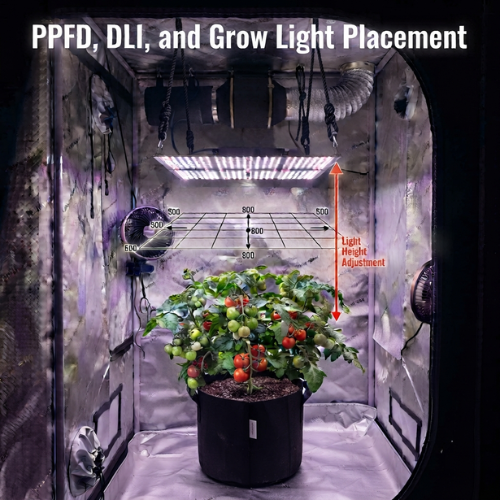
How hanging height changes everything
Light intensity follows the inverse square law: double the distance, and intensity drops to a quarter. Small height changes make big differences.
- Lower height: higher intensity, smaller footprint, higher risk of bleaching.
- Higher height: lower intensity, wider footprint, risk of underfeeding.
Manufacturer charts are a starting point. A PAR meter tells you what’s actually happening.
Hot spots and how to find them
Most lights don’t distribute evenly. The centre is usually stronger than the edges.
A PAR meter mapped across your canopy shows this clearly. Without one, edge plants often underperform simply because they’re receiving less light than the centre. Reflective tent walls help, but they don’t eliminate the gradient.
Dimming and why it matters
Running a light at full power isn’t always the best move.
Seedlings need gentle light. Plants acclimate better when intensity increases gradually. A dimmer lets you match intensity to growth stage without constantly adjusting height.
- Start seedlings around 50–60%
- Mid‑veg around 70–80%
- Flowering gets the full output
Slow increases beat sudden jumps every time.
CO₂ and its effect on light targets
At ambient CO₂ (around 400 ppm), most plants max out photosynthesis at roughly 800–1000 µmol/m²/s. More light above that doesn’t help.
With supplemental CO₂ (1200–1500 ppm), plants can actually use higher intensities effectively. Without CO₂, chasing huge PPFD numbers is just wasted electricity.
Getting a PAR meter
Quantum PAR meters used to be expensive. Now there are solid options at much more accessible price points such as the Treeger Quantum PAR Meter.
One mapping session tells you more about your grow space than any spec sheet ever will.
Map these points at canopy level:
- Centre
- Each corner
- Midpoints along each edge
You’ll see exactly how your light is distributed and where adjustments will make the biggest difference.
The takeaway
Buying a quality grow light is the start. Knowing what it’s actually delivering to your canopy is what separates growers who squeeze every bit of performance from their setup from those who leave yield on the table.
PPFD and DLI close that gap. Light placement makes your gear work harder. And once you understand how these pieces fit together, your plants respond every single run.